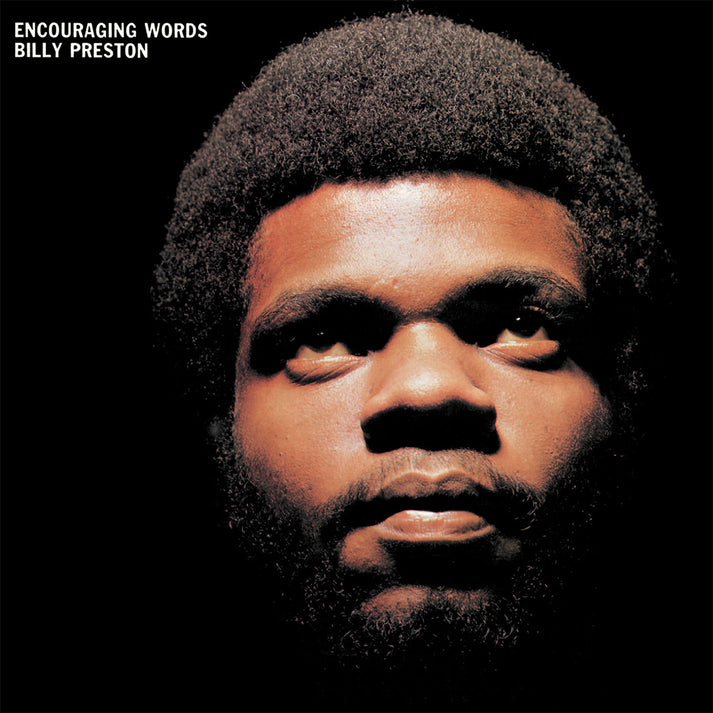
First released in the UK on 11 September 1970 the album was co-produced by Billy and George Harrison, with two of George’s songs – ‘All Things Must Pass’ and ‘My Sweet Lord’ – issued here for the first time, two months before his own recordings appeared on the triple album All Things Must Pass.In 2010 Record Collector magazine described Encouraging Words as “one of the finest titles in the Apple Records catalogue”, while virtuoso keyboard player Rick Wakeman told BBC Radio 4’s John Wilson he considered Preston’s two Apple albums “absolute gems – a perfect combination of gospel and funk.” The album was last released on vinyl in 1992.“Encouraging Words was about as fine an album as Apple Records ever issued by anyone who wasn’t a member of the Beatles, and it’s also better than many of the Apple albums issued by the ex-bandmembers; but it’s also among the most obscure of any album that the label ever issued by a major artist – without a hit single to drive its sales, the LP never did more than brush the very bottom of the charts, and it was quickly lost amid the financial collapse of the label and the implosion of the Beatles’ business ventures; even many Billy Preston fans never had a chance to find out it was there, obscured as it was by his subsequent chart success with ‘Outta Space’ on the A&M label.A bold and searing effort mixing gospel, soul, and rock sounds about as well as any record cut that year, Encouraging Words lived up its killer musical pedigree, partly an offshoot of the evolution of the Let It Be and All Things Must Pass albums, and of sessions that Preston and George Harrison had produced for Doris Troy; but it also picked up where Preston’s playing for Ray Charles had left off in 1968.The surging, soaring blues ‘The Same Thing Again,’ and the driving rocker ‘You’ve Been Acting Strange,’ both Preston originals, were worth the price of the album, but for those requiring familiar fare, Preston’s renditions of ‘My Sweet Lord,’ ‘All Things (Must) Pass,’ and ‘I’ve Got a Feeling‘ are here too, the first two as stunning gospel numbers (the second with some gorgeous jazz and classical embellishments) that make the Harrison versions seem pallid; and the latter a delightfully funky rendition that makes the Beatles’ recording sound like a classy demo; and for truly, delightfully strange sound amalgams, ‘Sing One for the Lord‘ manages to couple soaring gospel with some loud lead guitar and a piano part derived from Tchaikovsky (at least according to the annotator – this reviewer would have said Grieg).